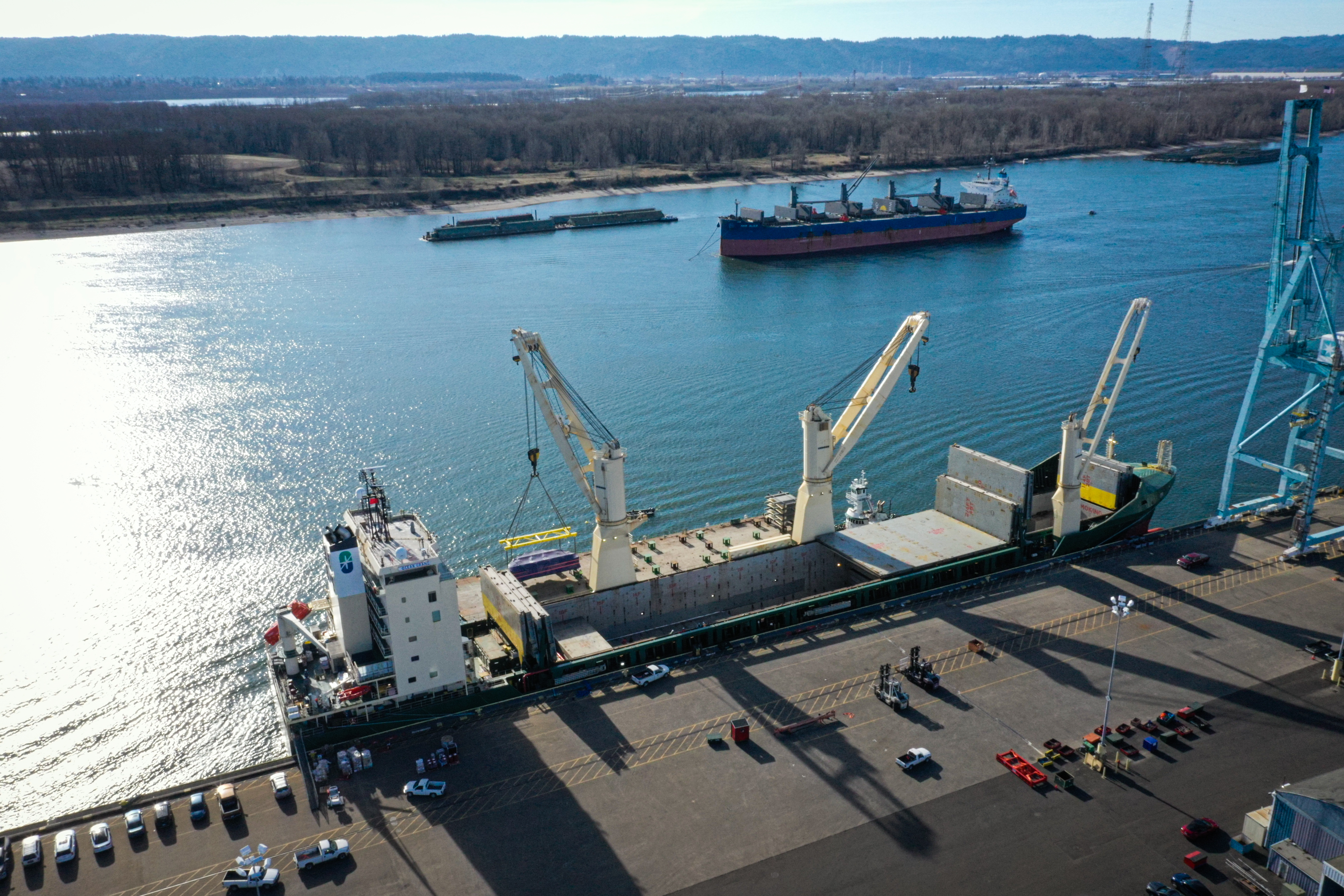
A module destined for Thacker Pass is moved from the MV Ocean Grand while docked at the Port of Vancouver USA. Photo courtesy of the Port of Vancouver USA.
Thacker Pass is being built in rural northern Nevada, but a lot of what makes that possible starts far from Humboldt County. One example is a river dock nearly 700 miles away in Washington State. It might seem like a stretch to connect a deep-water port on the Columbia River to our construction site, but everything that goes into building Thacker Pass has to get here somehow, and every mile traveled by equipment, parts and supplies puts American workers on the clock from dockworkers in Washington state, to truck drivers, and Thacker Pass workers here in Nevada. The Port of Vancouver USA has been one of the key starting points for the Thacker Pass supply chain journey.
In February 2026, the U.S.-flagged vessel MV Ocean Grand docked at the Port of Vancouver USA in Washington state, kicked off a months-long effort to move specialized modules bound for Thacker Pass. As of July, the port handled roughly 70,000 revenue tons (a shipping industry measure based on cargo weight or size, whichever is greater, not a literal ton count) of project cargo across five voyages, working closely with Lithium Americas' engineering, procurement and construction management (EPCM) contractor, Bechtel, to plan and execute the logistics.
The Heavy Lifting Required to Build Thacker Pass
“Building Thacker Pass takes partners like the Port of Vancouver USA who can help move complex, oversized equipment safely and efficiently across the country,” said Richard Gerspacher, Executive Vice President, Capital Projects & Operations. “Every piece that comes off a vessel in Washington and eventually rolls up US-95 and NV- 293 is the result of coordinated, multimodal logistics that make a project of this scale possible.”
Gerspacher added, “Working with the Port of Vancouver USA has given us the capacity and expertise to move heavy, complex cargo reliably, which keeps construction at Thacker Pass advancing toward our target of mechanical completion in late 2027.”
As Port of Vancouver USA Chief Commercial Officer Alex Strogen wrote in a recent LinkedIn article, “Moving the Cargo That Will Build America's Industrial Future,” the project reflects the port's commitment to strengthening America's critical minerals supply chain.
“We’re proud to play a role in powering communities and strengthening the industrial resilience of this country long term. Lending our expertise to this project also produces benefits to our local economy and workers,” said Strogen.
Water, Roads and Rails: Large Loads, Strategic Routes, American Hands
Because the Ocean Grand sails under the U.S. flag, the work supports American mariners at sea, and locally, it means steady hours for the longshoremen who load and move the cargo on the Columbia River.
For some of the largest components, the port's job doesn't end at the dock. For larger Thacker Pass modules, the Port of Vancouver USA uses barges and towboats to carry them farther down the Columbia River before they ever touch a highway.
It’s the same challenge our community has watched carefully play out on the ground: moving oversized crystallizer components and other significant equipment by road takes months of routing studies, permits and coordination with state agencies. On the water, barging offers solutions: it reduces the number of highway miles that large components have to travel, cutting down on the risk and cost of moving them over the road.
This kind of multimodal thinking out of Vancouver USA is the same logic behind our Iron Horse Nevada Transload Terminal, currently under construction in Winnemucca; it’s another link in the chain designed to move materials efficiently into and out of Thacker Pass.
Advancing America’s critical minerals supply chain and economic ripple effects
Though the port is several hundred miles away from Thacker Pass, connections are closer than they seem. These U.S.-flagged ships on the Columbia River, the barge working downriver and the superloads rolling through Utah, Idaho and Nevada are all part of a relay of American workers: manufacturers, mariners, dockworkers, truckers, Nevada Department of Transportation and Nevada State Police crews, each handing off the baton to Thacker Pass construction workers in order to bring critical mineral production home to U.S. soil. Keeping the relay on pace contributes to keeping Thacker Pass ramping up toward peak construction.
The Columbia River marine highway enables cargo to reach key projects throughout North America via the Port of Vancouver USA.